Weekly Member Update - September 28, 2026
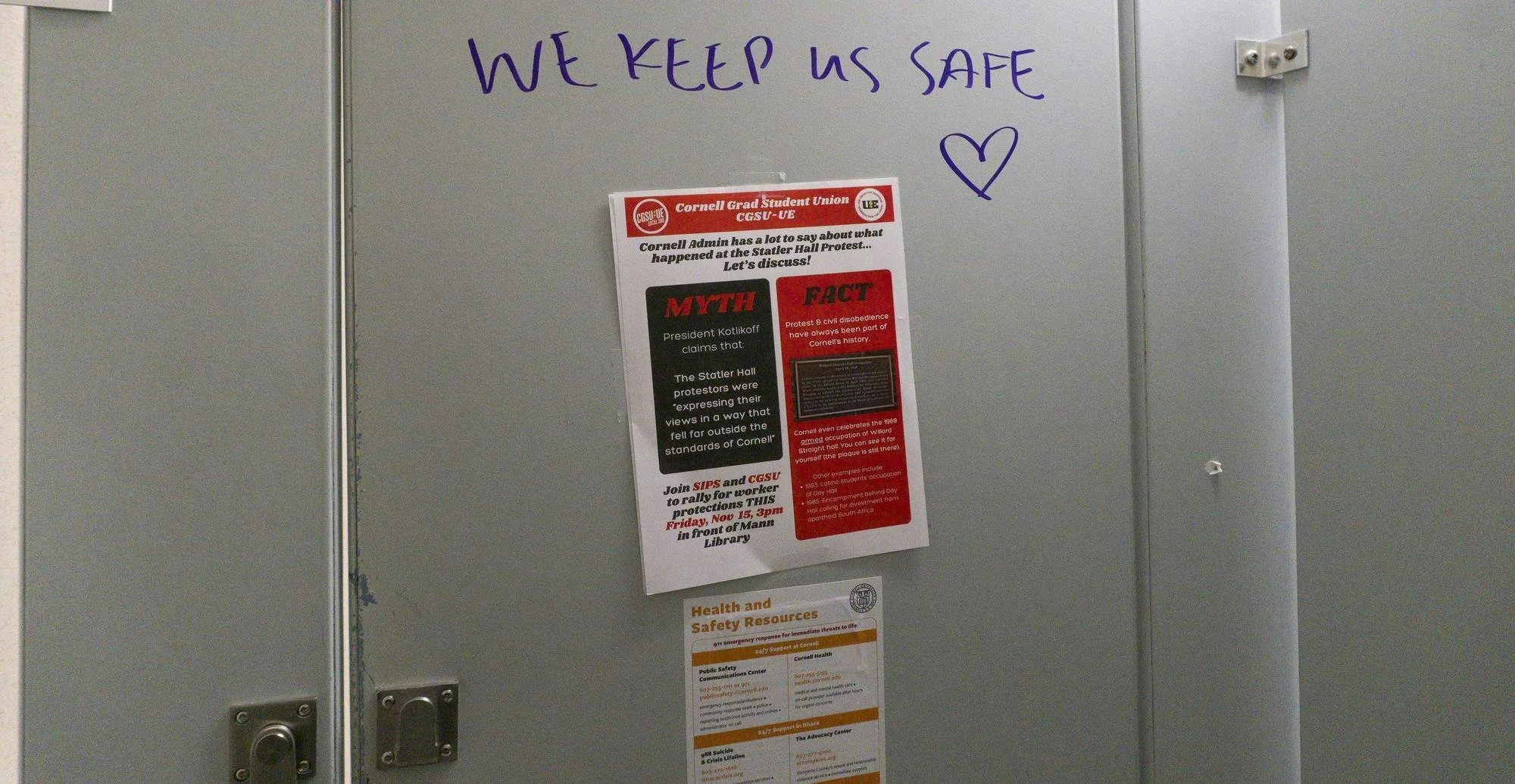
Grafitti in Uris Library Bathrooms at Cornell University on Nov. 16th, 2024. Photo by Sophia Romanov Imber / The Cornell Daily Sun.
You’ve likely heard by now that Jane Doe has sued Cornell University, among others, for damages arising from the horrific gang assault which she endured at a Cornell fraternity in October 2024. Jane Doe’s complaint not only sets forth the stomach-churning details of the horror that she was subjected to over a seven-hour span that night, it also summarizes Cornell’s despicable history of not taking on-campus sexual assault seriously. Quite frankly, we hope that Jane Doe drives Cornell into bankruptcy, but even if she does, it won’t be enough. We can’t say it any better than the Editorial Board of Cornell’s student-run, independent newspaper, The Cornell Daily Sun:
“We refuse for this victim to be reduced to just another story. Cornell has failed to protect its students. Cornell has failed to address the growing issue of sexual assault on campus with its pathetic task force. Cornell has failed the student allegedly raped by those seven men at Chi Phi in October 2024. Cornell has failed her. Cornell has failed us.”
If you are hoping, first and foremost, for consequences for the seven frat boys who allegedly perpetrated this heinous assault, we suggest that you bookmark The Cornell 7, a website now under construction by former South Park writer Toby Morton, who promises relentless accountability for all those involved, from the perpetrators themselves to all the Cornell officials who tried to sweep it under the rug.
By happenstance, Representative Alexandria Ocasio Cortez was in Ithaca last night for a “Students vs. Billionaires” Town Hall. As reported by the Cornell Daily Sun, AOC opened her remarks to the crowd by condemning the “culture of rape” that exists in higher education institutions like Cornell:
“Jane Doe, that survivor, lost her education because you can’t stay in school when something like that happens to you. She had to lose her education, and those men were protected by an institution and granted an Ivy League degree as a reward. Never again … The culture of rape, sexual assault and pedophilia is protected in elite institutions across the United States, including Cornell University … it has got to stop. This entire country is sick and tired of not just financially corrupt, but morally corrupt leadership.”
The Week in Flock
The biggest Flock story locally this week came from Dutchess County, where officials announced that all 65 of the County-operated Flocks would be immediately deactivated and will be removed at a later date. What really stuck with us about this latest episode of Getting the Flock Out isn’t just the fact that the cameras are being removed, but the reasoning which County officials gave for the removal. Dutchess County District Attorney Anthony Parisi and Sheriff Kirk Imperati issued a joint statement in which they acknowledged their collective belief that Flocks “could help law enforcement protect people and investigate serious crimes.” Nonetheless, Parisi and Imperati decided that the overriding consideration was the widespread and bipartisan citizen opposition to the cameras. “Sheriff Imperati and I met following several community forums and spent considerable time discussing what we heard from residents,” Parisi said in a statement. “We listened to the questions that were asked and the concerns that were raised. After those discussions, we agreed that the appropriate response is to listen to our community and change course.” Dutchess County Executive Sue Serino applauded County law enforcement for being responsive to its constituents and pledged to reallocate the nearly half a million dollars in Flock contract costs to other purposes, “including EMS services, veterans, seniors and youth programming.”
If only some of our own communities followed Dutchess County’s example. Far too often, what we hear from local police and elected officials is how useful or effective Flocks and other ALPRs are in fighting crime, or how they make cops’ jobs “easier.” We’ve never disputed these points, but we’ve always taken the position that the utility of this technology is only part of the calculus. After all, we’re sure that doing away with pesky constitutional impediments like judicial warrant requirements and the concept of probable cause would undoubtedly make the work of police “easier” and would help solve crimes. But, for those of us who are deeply invested in the DeFlock movement, solving crime is not the be-all, end-all. To us, the undeniable crime-fighting positives attendant to ALPRs are dramatically outweighed by the way that the all-watching eyes impede all of our constitutional rights and eliminate personal privacy, not to mention the data security issues, the high risk of inaccurate data collection and the rampant scourge of abuse of the devices that ALPRs invariably present. So, when you hear folks like Troy Mayor Carmella Mantello, or Rensselaer County District Attorney Mary Pat Donnelly, or Albany County Sheriff Craig Apple talk about how useful ALPR technology is, keep reminding them of the considerable cons that come from the surveillance state. Maybe someday they’ll listen to the people, follow Dutchess County’s lead and do the right thing.
Flock claims that it has 120,000 cameras in place across the Country, but the Flock Surveillance Map suggests that Flock has closer to 350,000 devices scattered throughout our communities; we had no idea that Troy has sooooo many Flock Raven audio detection devices, for example. No wonder Flock wants to shut the Map down.
Indianapolis is the latest municipality to be confronted with news that its cops have abused Flock surveillance technology for their personal objectives. On the heels of Washington Post reporting on the malfeasance, five Indy cops were charged this past week for conducting thousands of unauthorized Flock searches, and one of those cops, Jonathan Schultz, specifically used the cameras to track women he didn’t know but whom he was romantically interested in.
In Athens, Georgia, a civilian crime analyst was arrested for using Flock to monitor the movements of his ex-wife.
As some US Senators call for greater safeguards on law enforcement misuse of ALPRs, the Senate Judiciary Committee held a hearing this past Wednesday called “Always Watching: Flock’s Nationwide AI Surveillance Network.” Among the witnesses to testify was Floridian Lindsey Isaacs, the 23-year old woman who was wrongfully imprisoned for 13 days when a Flock camera inaccurately linked her vehicle to a fatal traffic accident. Flock representatives, including camera-shy CEO Garrett Langley, declined the opportunity to appear before Congress, however.
Meanwhile, Langley and other Flock execs are contemplating selling the company off for parts before it collapses completely.
Here in the 518, the Town of Guilderland officials seem intent on pretending that the Flock problem doesn’t exist.
Odds & Ends
Do yourself a favor and read “When the Weed Wars Came to Warren Street,” The New York Times deep dive onto the gentrification of Hudson, the Rockefeller drug wars, and how capitalism and privilege have misappropriated the restorative justice objectives of New York’s marijuana legalization.
In another piece, The New York Times reports on Amazon delivery drones taking over the sky above Richardson, Texas. Richardson is just the beginning, as Amazon has plans to have drones fill the skies over 500 more towns and cities by the end of this year.
If you haven’t read ProPublica’s reporting on the pay-for-play scandal enveloping concerned Maine Senator Susan Collins, you absolutely should.
You’ve likely heard the story of Wilber Rafael Garcés Perez, the Venezuelan DoorDasher in Texas who was shot in the back by ICE during a traffic stop. DoorDash spent more than a million dollars to try and stop Zohran Mamdani from being elected Mayor of NYC, but the company hasn’t said a word about the terror campaign that ICE has been waging throughout the Country on Dashers like Garcés Perez. Now, District of Columbia activists have launched the Delete DoorDash campaign.
Israeli Prime Minister Benyamin Netanyahu was in NYC this past week to call Mamdani an anti-Semite and give an address to a near-empty United Nations General Assembly hall. Outside, more than 100 protestors, including actresses Hannah Einbinder and Susan Sarandon, were arrested while engaging in civil disobedience. Also among those arrested were Democratic House candidates Brad Lander and Darializa Avila Chevalier, the latter of whom explained why in The Guardian.
With Election Day only 36 days away and early voting already underway in several states, the polling for Republicans continues to crater everywhere. Meanwhile, Chuck Schumer is still deciding on whether the Democratic Senatorial Campaign Committee is going to give financial support to Florida progressive Senate candidate Angie Nixon. While Chuck ruminates, you can donate to Angie Nixon here.
Environmentalist Bill McKibben, writing for Rolling Stone, calls Republican NY-21 Congressional candidate Anthony Constantino “everything that is wrong with our politics.”