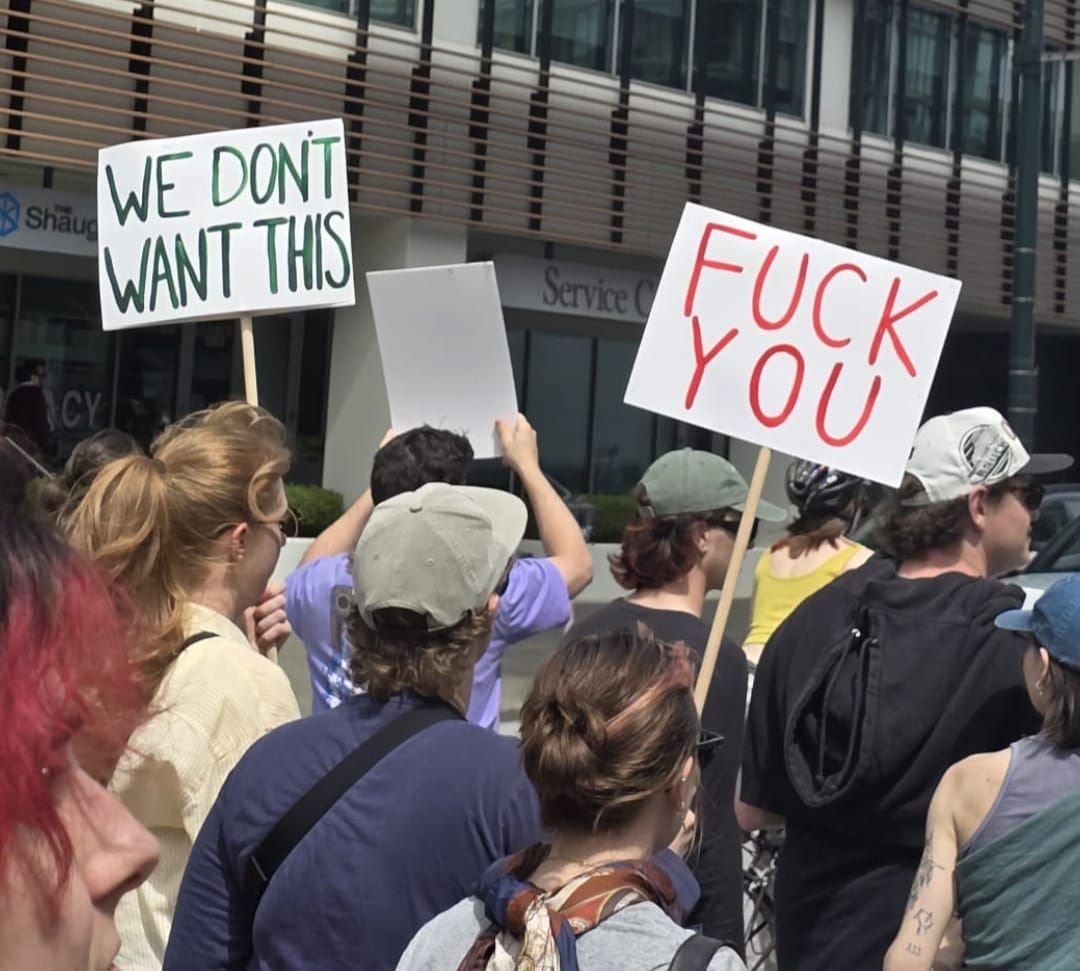
Protestors in Vancouver, B.C. demonstrate against planned AI data center expansion in the City on May 23
At our upcoming Member Meeting on June 8, we’ll be hosting a community forum we’ve entitled Stop Invasive Tech - The Rise of the Machines in the Capital Region. The impetus for this forum is not just our longstanding work against AI-powered Flock mass surveillance in our local communities — although we will of course be discussing that topic — but also the recent news that a data center is under consideration for the former Kenwood Convent site in Albany’s South End, as well as the fact that our own State Senator, Patricia Fahy, is sponsoring legislation to make the Capital Region a guinea pig for the introduction of Waymo driverless vehicles Upstate. But frankly, we also feel like we’re tapping into the rising national zeitgeist with this forum. The mere mention of artificial intelligence is being lustily booed at commencement addresses across the Country, and no less a figure than Pope Leo XIV has issued Magnifica Humanitas, an Encyclical Letter “on safeguarding the human person in the time of artificial intelligence.” Leo’s Encyclical — which we encourage everyone to read for themselves, regardless of your religious persuasion — speaks with grace and beauty about universally human themes like social justice, the common good and the dignity of work, and ultimately warns against the “idolatry of profit that sacrifices the weak, a uniformity that neutralizes differences, and the pretense that a single language — even a digital one — can translate everything, including the mystery of the person, into data and performance.” As The New Republic has noted, however, Leo’s work is more than a treatise on the moral, societal and spiritual perils which AI poses to modern life, it is also a “direct challenge to the political and economic might wielded by American tech oligarchs.” And it’s not just the Pope, Amnesty International has labeled generative AI as “fundamentally incompatible” with international human rights law.
The growing public disdain for everything AI and the billionaires that love it turns into torches and pitchforks when talk turns to the data center infrastructure that makes AI possible. In early May, the New York Times called opposition to data centers “The Most Bipartisan Issue Since Beer.” In April, just days after the City Council of Festus, Missouri had approved a data center for that City over vociferous citizen objections, the enraged electorate resoundingly voted half the City Council out of office; the City’s Mayor and the remainder of the City Council are now the subject of a recall petition. Also in April, the Milwaukee suburb of Port Washington enacted the nation’s first voter-initiated referendum restricting the future construction of data centers, and similar measures are on the ballot later this year in Monterrey Park, California, Augustus Township, Michigan and Janesville, Wisconsin. And to top it off, the increased electrical demand posed by data centers is causing states to scuttle their previously enacted climate goals. Even Erin Brockovich is getting involved in the anti-data center movement. Of course, the Trump Administration, which never seems shy to get on the wrong side of an issue that the American people abhors, is considering labeling those opposed to data centers and AI writ large as “anti-technology extremists.”
We see no indications that the Capital Region is going to be any more welcoming to a data center in our own community. As we said last week, the City of Albany Planning Board issued a rare public notice advising the public that the Kenwood data center project is not on the Planning Board agenda for tomorrow night, but we expect that people are going to show up there regardless. As the Times Union pointed out this week, the data center has a long road to hoe before it can be built. Meanwhile, we have it on good authority that a data center moratorium bill is going to be circulated to the members of the Albany Common Council tonight, and we wouldn’t be surprised if members of the community show up at the Common Council meeting as well. And, it’s possible that the State will take the matter out of localities’ hands; a bill sponsored by Manhattan State Senator Liz Krueger and Ithaca Assembly Member Dr. Anna Kelles would impose a three-year moratorium on all data center permitting so as to permit the Public Service Commission to study the issue more thoroughly. The Times Union Editorial Board spoke approvingly of the state moratorium bill this past week, and both Senator Fahy and Assembly Member Gabriella Romero have now signed on as additional co-sponsors. Hell, even Albany County Executive Dan McCoy seemed tepid about the Kenwood data center when he addressed the issue on Facebook this past week, but we all know that he could probably be persuaded to support it if they called it the “Daniel P. McCoy Data Center” and let him put his picture on it.
Speaking of McCoy, one of our Bluesky followers pointed out this week that Danny referred to the Spring 2026 edition of the Albany County Newsletter as “the first edition of my Albany County newsletter.” Ick. Well, there’s apparently a whole lot more to that story. According to juicy reporting by the Times Union’s Patrick Tine, Albany County officials won’t speak to the Times Union about who produced the “glossy, color spring newsletter from McCoy that [C]ounty residents began receiving in the mail over the last week.” However, there is apparently a second quarterly newsletter now in the works which will feature McCoy and highlight the County’s “economic development” efforts. This second newsletter will be produced by the Baker Agency, an Albany-based public relations firm, pursuant to a $133,000 contract awarded to Baker by the County on May 13. According to the Times Union, there were 17 other bidders for this public relations project and at least one of them — Joe Bonilla’s Relentless Awareness — offered to do the work for a “fraction” of Baker’s price. One final nugget about this latest McCoy promotional project; it will include an economic development podcast called “Getting the Deal Done” featuring McCoy and Advance Albany County Alliance CEO Kevin O’Connor. Just like the newsletter, this will be McCoy’s second podcast, joining the County-produced “Albany County Direct” which got under way last March.
The Race for Albany County Judge
If you are voting in Albany County in this month’s primary elections, chances are that you’ll only be voting in two races. Unless you’re a voter in Berne, Knox, Westerlo, Rensselaerville or parts of Selkirk — all of whom have an Assembly race to vote in — or you vote in a smattering of other wards or districts where there is a contested primary to be a Member of the Albany County Democratic Committee — Romero and Nesta Littlejohn, the Chief of Staff to Albany Mayor Dorcey Applyrs, have a challenger for their two Committee seats from attorney Jennifer Morton, for example — you only get to vote for the Democratic nominee to be State Comptroller (which we discussed last week) and the Democratic nominee to be the next Albany County Judge. In the New York judicial system, a County Judge is principally a criminal-court judge who is responsible, in theory, for maintaining the proper balance between the rights of the citizenry and the need for public safety. When a criminal defendant seeks to suppress evidence obtained in violation of their rights, chances are that a County Judge will make that call. When a criminal defendant is found guilty of crimes beyond a reasonable doubt, it will generally be a County Judge that decides the punishment to be imposed on that defendant. It’s an important job with tremendous responsibilities.
This being Albany County, the Democratic primary later this month will pretty much determine who gets to hold the Office of Albany County Court Judge from January 2027 through 2036. The Office has been vacant since January 2026, when Judge William Little moved up to State Supreme Court, so there is no incumbent; its a free-for-all between three experienced local lawyers, but none of whom have ever served as a Judge before. The machine-endorsed candidate is Joe Meany, a former public defender and judicial law clerk who is now a prosecutor in the Albany County District Attorney’s office, where he serves as Chief Assistant to District Attorney Kindlon. Meany has the imprimatur of local electeds like Senator Fahy, Assembly Members Romero and John McDonald, and Albany County Sheriff Craig Apple; and, as further proof of his establishment bona fides, he boasts the endorsement of the Albany County Democratic Committee, the Albany County Democratic Party Chair and the Albany County Young Democrats. With machine support like that, Meany is clearly the prohibitive favorite, but it says something about the current state of political affairs that Meany has not one, but two primary challengers. If you’d prefer that your candidate be merely establishment-adjacent, John Czajka is also on the ballot. Czajka is the brother of Albany County Family Court Judge Jaime Czajka and the nephew of longtime Columbia County Judge and District Attorney Paul Czajka. Candidate Czajka began his local legal career as a prosecutor in the Office of the Albany County District Attorney’s Office, but has spent the majority of the last 15 years in government, including as Counsel to the New York State Police and in the administration of Governor Andrew Cuomo. Finally, if there is an underdog in this fray, it is probably Tina Sodhi. Sodhi has spent her entire 20-year career representing economically disadvantaged folks as a public defender in Albany County and, if elected, she would be only the second woman elected to Albany County Court and only the third person of color to hold that office.
As usual, we’re lamenting the lack of ranked choice voting in a race like this. With two establishment/quasi-establishment white dudes in the race representing competing factions of the Albany machine, one could imagine Sodhi garnering a lot of second-choice votes and, in a ranked-choice system, everybody’s second choice has a way of becoming the consensus that the majority ultimately approves of. Alas, there will be no RCV in Albany County this year, so we’re left to dream.
The Week in Flock
A couple of weeks ago, we talked about how The City of Dayton, Ohio indefinitely suspended its use of Flock surveillance cameras upon the revelation that the data collected by Flock was being used for immigration enforcement, in violation of Flock’s contract with the City. Well, suspension notwithstanding, the cameras remain, still seemingly feeding data to Flock’s servers. The City police and residents are now taking measures in their own hands and are covering the cameras with bags. The people of Evanston, Illinois are doing the same thing as they wait for their Flocks to be removed and, just this past weekend, our friends in Ithaca started rallying the community to cover the cameras there while they await their removal. Just a reminder that Flock doesn’t operate in good faith; even when you beat them and persuade the police and the electeds to end the contracts, the cameras keep clicking away.
The school bus safety company Bus Patrol, which has outfitted more than 40,000 school buses — including in the Troy City School District —with AI-powered stop-arm and other exterior cameras, is planning on converting its cameras into ALPRs and turning that data over to police without a warrant. Big rolling yellow Flocks, essentially.
The Troy City Council is holding a public hearing this coming Thursday at 5:30 on Troy’s proposed Local Law #3, which purports to place “clear limits on the use, retention, and sharing of captured [ALPR] data” by City entities, including Troy PD. We’re not Trojans, but we’re concerned about the precedent that this proposed Local Law might set for the entire Capital Region. To that end, we’ve already expressed our skepticism about whether this law goes far enough. Our primary objection is this; Troy’s proposed Local Law explicitly contemplates the continued existence of private “contractors” (read: Flock surveillance) to administer Troy’s ALPR network. So, while Local Law #3 would purport to limit its data retention to 48 hours and claims to prohibit data sharing with external agencies in the absence of a judicial warrant, it overlooks the fact that Troy lacks the fundamental tool necessary to enforce those restrictions, that being the exclusive control over its own data. When you drive by a flickering Flock coming off the Congress Street Bridge, for example, that data goes immediately to Flock’s servers in Georgia and, when the Troy PD wants to access that data, they need to ask Flock to see it via Flock’s dashboard. If Troy PD enters into a data sharing agreement with “a local law enforcement partner” — say, the Rensselaer County Sheriff, by way of logical example — that partner isn’t accessing Troy’s data through Troy directly; instead, Sheriff Bourgault and his crew are going to Flock to get it. So, unless Troy is going to have no data sharing agreements whatsoever — and that kinda defeats the entire purpose of ALPRs from a law-enforcement perspective; if Troy popo can’t see where the ne’er-do-wells are going after they leave the Troy City limits, then what’s the point? — Troy’s data retention policy and warrant requirements are an illusion wrapped in legalese. The bottom line is this, if a billion-dollar corporation like Flock surveillance controls all the valves through which Troy’s data flows, Trojans should have no expectation whatsoever that their data will be expunged in 48 hours or that any of the myriad local, state and federal law enforcement agencies that work with Flock will not be able to circumvent Troy’s local warrant requirement to get the data they want directly from Flock. We therefore see Local Law #3 as a performative exercise which pretends to find some sort of “middle ground” by preservation of the status quo and imposing rules that Troy officials are in no position to enforce. The only real answer, in our view, is to Get the Flock Out.
Odds & Ends
We have more details on our celebration of Capital Pride on June 14. Frankly, we can think of no better way to commemorate Trump’s birthday — and the one-year anniversary of No Kings I — than by marching in the jubilation of Pride. Let us know if you plan on marching with us!
Acting Attorney General, and Trump’s personal lawyer, Todd Blanche is the subject of a disciplinary investigation by New York bar authorities in Manhattan. Among the many allegations is a profound conflict of interest related to Blanche’s “interview” of Ghislaine Maxwell, and Blanche’s involvement in the persecution of Kilmar Abrego Garcia.
Although a federal judge has paused Trump’s $1.776 billion insurrectionist slush fund, Manhattan Assembly Member — and US House candidate — Alex Bores has proposed legislation to impose a 100% tax on any proceeds dispensed to New York residents. Eighty+ New Yorkers have been linked to the January 6 insurrection, including multiple Capital Region residents.
Speaking of recidivists, the Times Union has the story of Albany County Sheriff Senior Investigator Ryan Cross. According to the Office of the Attorney General, Cross violated the civil rights of Albanians on five separate occasions. Cross also has a lengthy disciplinary history, having been cited for misconduct repeatedly between 2011 and 2018, including one incident in which Cross was found to have been drunk on duty. Criminal defense attorneys throughout the Capital Region will surely be looking forward to seeing Cross’s name in their discovery disclosures.
Habeas Flight Watch is new online tool to track domestic ICE flights in real-time and predict their schedules.
Perhaps Alexander Jose Regnault-Avila and his four-year-old daughter will soon be on one of these ICE flights. Amid a decided recent uptick in ICE activity in our local communities, Regnault-Avila and his daughter were taken by ICE on Friday morning as the child was being taken to school in the City of Albany. As ICE activity increases, follow the Capital Region Sanctuary Coalition for more information, including all hands alerts.

Protesters clash with ICE agents outside Delaney Hall in Newark, New Jersey, May 26. REUTERS/Ryan Murphy
Finally, when you’re on the street protesting Citizens Bank this coming Saturday, remember to connect the dots. Citizens Bank underwrites The GEO Group, and The Geo Group is the private prison contractor running Delaney Hall in Newark, New Jersey. So Citizens Bank has helped make the atrocity of Delaney Hall possible. As The GEO Group makes millions with the help of Citizens Bank, the hundreds of people GEO is imprisoning are subjected to physical and psychological torture. Remember this on Saturday.